Key takeaways
- The material and its condition should decide the cleaning method, not a preference for maximum pressure.
- Lightning Clean soft washes render rather than cleaning it at high pressure.
- Roof work may use manual moss removal, low-pressure steam or soft washing, followed by biocide.
- Controlled pressure washing is best reserved for suitable hard surfaces such as many drives and patios.
“Soft washing” and “pressure washing” are often used as if they describe the same job at different power settings. In practice, they are different approaches. Each has a useful role, but applying the wrong one to a delicate or weathered surface can produce a poor result.
The safest starting point is not “How powerful is the machine?” It is “What is this surface, what is growing on it, and what condition is it in?” A professional should answer those questions before selecting equipment and treatment.
What pressure washing does
Pressure washing uses a controlled stream of water to lift dirt, organic growth and surface staining. Professional equipment can be adjusted and paired with suitable attachments, but the method still depends substantially on water pressure and technique.
It is particularly useful on robust exterior surfaces. Lightning Clean uses professional pressure washing for suitable block paving, tarmac, concrete, resin-bound surfaces and natural stone, as well as controlled cleaning for timber or composite decking. The precise approach has to reflect the material.
Even within that list, surfaces are not identical. An old patio with loose pointing is different from sound concrete. Natural stone varies. Decking requires a gentler process than a hard driveway. Existing cracks, loose areas or failing finishes should be identified before work starts, with repairs referred to an appropriate tradesperson where necessary.
For suitable outdoor surfaces, read more about professional pressure washing for driveways, patios and decking.
What soft washing does
Soft washing uses low-pressure application with specialist cleaning treatment to target organic contamination. The treatment does more of the work, so the surface does not have to be subjected to the concentrated force associated with high-pressure cleaning.
This makes soft washing appropriate for surfaces where algae, lichen, moss or red staining need to be treated carefully. Lightning Clean uses specialist soft washing and professional biocide treatments for roof and render projects, selecting the actual process for the substrate and its condition.
“Soft” does not mean casual or universally harmless. Products must be selected, diluted and applied correctly, and nearby materials and planting need proper consideration. It is a professional process rather than a reason to spray a general household chemical over an elevation.
Why render usually needs the gentler option
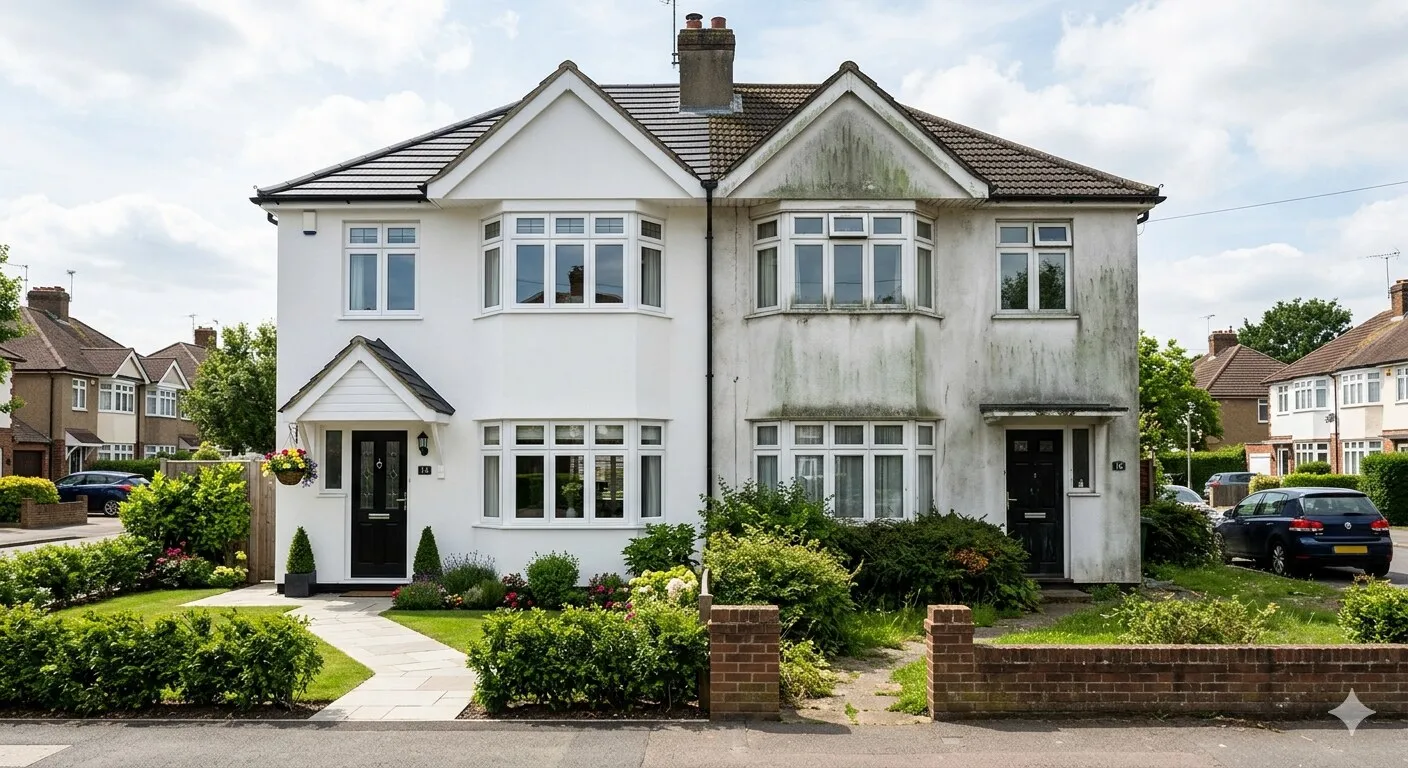
Rendered walls can become marked by algae, red staining, atmospheric pollution and weathering. High pressure is not Lightning Clean’s method for these surfaces. Instead, render is gently soft washed, then treated with professional biocide to target remaining spores and help inhibit regrowth.
That approach is intended to clean the appearance without relying on aggressive water force. It is still important to inspect the wall first. Cracks, hollow areas, failed coatings or water entry are maintenance issues, not dirt. Cleaning cannot repair them, and a builder, renderer or surveyor should assess concerns before the surface is treated.
Older homes and varied finishes need particular care. In places such as Romsey, where historic brick and rendered homes sit alongside newer properties, there is no sensible one-method-fits-all answer. Identification comes before cleaning.
Roof cleaning is not simply pressure washing
A roof has its own access, material and drainage considerations. Lightning Clean tailors roof cleaning to the individual project. Depending on the surface and condition, the process may involve manual moss removal, low-pressure DOFF-style steam cleaning or specialist soft washing. Roof cleaning is then finished with a professional biocide treatment to inhibit regrowth.
That range matters because roof coverings vary. Slate, tiles and other materials can differ in age, fixing and condition. Visible moss does not tell you everything about what is underneath it.
Cleaning also should not be presented as a repair. Broken or slipped tiles, failing flashing, suspected leaks or signs of structural movement require a roofer or surveyor. Those issues should be assessed before cleaning proceeds.
Our roof cleaning service and render cleaning service explain how the method is chosen around each surface instead of using one process everywhere.
Where pressure washing earns its place
On a suitable driveway or patio, controlled pressure washing can remove built-up dirt, weeds, moss, algae and staining effectively. Lightning Clean follows the clean with soft wash or biocide treatment where stated to reduce organic regrowth.
Technique still matters. Working too aggressively can disturb jointing sand, expose weak pointing or leave conspicuous lines. Edges, drainage, adjacent doors and walls also need attention. A professional clean should account for where dislodged material and water will go, not merely change the colour of the central area.
Timber and composite decking deserve special mention. They can be cleaned, but require controlled, gentle treatment. High force close to the surface is not the benchmark for a thorough job.
A simple way to choose
Use this decision sequence when discussing a quotation:
- Identify the material. Render, roof covering, concrete, block paving, stone and decking all behave differently.
- Check its condition. Note cracks, looseness, failing coatings, damaged pointing and previous repairs.
- Identify the contamination. Loose dirt, moss, algae, lichen and red staining may call for different treatment.
- Select the least aggressive effective method. More pressure is not automatically more professional.
- Plan the finish. Ask whether a biocide treatment is appropriate and what areas are included.
This is especially relevant around older or sensitive materials. Exterior cleaning in Winchester, for example, can involve historic brick, clay tiles and stonework where a low-pressure, surface-aware approach is important.
Questions worth asking before work begins
Ask the contractor to name the process proposed for each surface. “Cleaning the exterior” is too vague if the project includes both rendered walls and a block-paved drive.
Confirm whether visible defects need attention first, whether windows or neighbouring surfaces require protection, and what the expected change will be. Organic treatment can continue working after application, so the final appearance may not always be immediate. The contractor should explain the process rather than promise that every mark will respond in exactly the same way.
Finally, separate maintenance from diagnosis. Cleaning can remove contamination and improve appearance; it cannot certify a roof, solve structural movement or replace failed render. Where the condition is uncertain, pause and ask a roofer, renderer or surveyor to assess it.
Choosing between soft washing and pressure washing is therefore straightforward in principle: understand the surface, use the method suited to it, and avoid unnecessary force.
Common questions
Frequently asked questions
Is soft washing the same as pressure washing?
No. Pressure washing relies mainly on controlled water pressure to remove surface contamination. Soft washing uses a low-pressure application and specialist treatment chosen for organic growth and the material being cleaned.
Should render be pressure washed?
Lightning Clean gently soft washes render rather than using high pressure, then applies a professional biocide treatment to target remaining spores and help inhibit organic regrowth.
How does Lightning Clean clean a roof?
The approach depends on the roof and its condition. It may include manual moss removal, low-pressure DOFF-style steam cleaning or specialist soft washing, followed by a professional biocide treatment.
Ready to price your exterior clean?
Tell us about your property and the surfaces you would like professionally cleaned.
Get an instant estimate