

Key takeaways
- Start with an annual gutter check, then adjust for nearby trees and known trouble spots.
- Late autumn is useful after leaves have fallen; spring is a good time to check winter debris.
- Overflow, sagging, plant growth and staining are signs that water may not be flowing correctly.
- Ground-based vacuum clearing avoids leaning ladders against the property.
Gutters are easy to forget because, when they work, rain disappears quietly into the downpipes. A blockage often becomes obvious only during a Hampshire downpour, when water runs over the edge or finds another route down the building.
There is no single timetable for every property. The right frequency depends on trees, roof shape, exposure and how quickly debris collects. A sensible plan combines a regular check with extra attention after periods that are likely to fill the guttering.
A practical starting point
For many Southampton and Hampshire homes, checking the gutters once a year is a reasonable baseline. That does not mean every gutter will need a full clear on exactly the same date. It means looking for accumulated leaves, moss and debris before they stop rainwater moving towards the outlets.
Homes close to mature trees may need checking more frequently. A roof beneath oaks, sycamores, pines or nearby woodland can receive leaves, needles, twigs and seeds at different points in the year. Moss loosened from roof coverings can also settle in the channel and gather around an outlet.
Leafy neighbourhoods such as Bassett, where mature trees are a common part of the streetscape, can therefore need a more responsive routine than an exposed property with little overhanging vegetation. Watch how your own building behaves rather than relying only on the calendar.
How the Hampshire seasons affect gutters
Autumn: the main leaf fall
Late autumn is the obvious time to think about gutter clearing. It’s generally best to wait until most of the surrounding leaves have fallen before clearing the gutters. Doing so too early in the season can risk them quickly filling up again.
A visual check after windy weather is useful. Valleys, roof junctions and sections below overhanging branches can collect debris faster than a straight, open run. If one elevation always causes trouble, note it for the next inspection.
Winter: heavy rain exposes weak points
Winter rain does not necessarily create a blockage, but it reveals one. Watch the building during steady rain from a safe position at ground level. Water should enter the gutter and travel towards the downpipe without spilling over the front or tracking behind it.
Storms can move twigs, moss and loose material into an outlet. If overflow starts suddenly, arrange a check rather than waiting for the next annual visit.
Spring: check what winter left behind
Spring is a useful second checkpoint, especially around wooded plots. Winter debris may have compacted, while seeds and organic material can begin to sprout in neglected guttering. Small plants are not just unsightly: they show that enough material has collected to retain moisture and support growth.
Summer: use dry weather for maintenance
Longer, drier days can make planned exterior maintenance easier. Summer is also a chance to review roofline areas that were difficult to assess during wet weather. A dry spell does not make a blocked gutter harmless; the blockage will still be there when rain returns.
Signs your gutters need attention
You do not need to climb a ladder to spot many warning signs. Look from the ground, and never lean out of an upstairs window to inspect a difficult section.
- Water spilling over the edge: the channel or outlet may be obstructed, incorrectly aligned or unable to cope because flow is restricted.
- Water appearing behind the gutter: this deserves attention because rain is not following its intended route.
- Sagging or uneven sections: retained wet debris adds weight and may reveal a loose fixing. If the guttering itself looks damaged, Lightning Clean can diagnose the problem and, in many cases, refit or replace clips. If another trade is needed, we will tell you whether to contact a roofer or a guttering specialist.
- Plants or visible moss: growth above the roofline usually indicates material has been sitting there for some time.
- Staining on fascias, soffits or walls: marks can indicate repeated overflow, although other causes are possible.
- A downpipe that stays quiet in rain: if neighbouring outlets are running but one is not, its entrance or pipe may be obstructed.
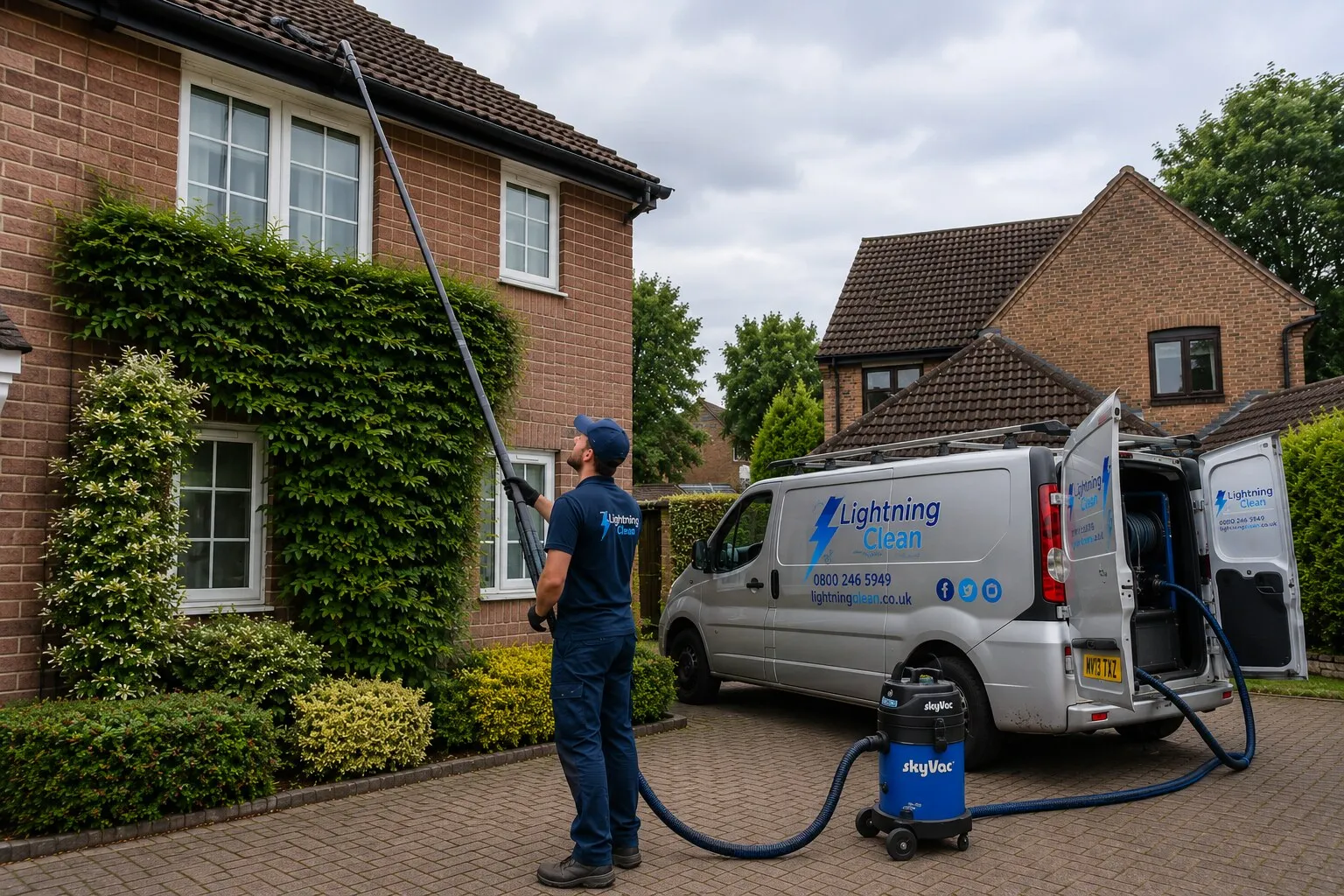
Lightning Clean’s ground-based gutter clearing service removes leaves, moss and debris with a professional SkyVac system and includes a check that downpipe outlets are flowing freely.
Why overflow should not be ignored
Guttering is designed to direct rainwater away from roof edges and exterior walls. When that route is blocked, repeated overflow can soak and mark roofline finishes and walls. Water may also pool beside the property instead of reaching the intended drainage point.
Clearing debris alone cannot correct failed seals, a gutter that does not slope enough towards the downpipe so water sits in it, cracked components or an unsuitable drainage layout. If water still escapes after debris has been removed, Lightning Clean can diagnose the problem and, in many cases, reseal small joint leaks or clear blocked downpipes. If another trade is needed, we will explain the issue and tell you what kind of professional to call, such as a roofer or a guttering specialist.
The same distinction matters when damp is visible indoors. Do not assume gutter clearing will solve it. Indoor damp can have several causes, and an appropriately qualified professional should investigate persistent or serious signs.
Trees, roof moss and recurring blockages
Cutting back vegetation may reduce the amount entering a gutter, but tree work should be planned safely and with any relevant protections in mind. The practical first step is often simply to shorten the inspection interval.
If pieces of moss repeatedly wash down from the roof, clearing the gutters deals with the immediate obstruction rather than the source. A surface-appropriate roof assessment may help. Lightning Clean’s roof cleaning service can involve manual moss removal, low-pressure steam or soft washing, followed by biocide, depending on the roof and its condition.
Properties around woodland-edged Chilworth may experience both leaf fall and shaded organic growth. Again, this does not create a universal schedule; it is a reason to observe the building more closely.
Build a simple gutter routine
Put a reminder in your calendar for after the main autumn leaf fall. During the year, glance at the roofline whenever there is sustained rain. Keep a note of the sections that overflow first, because those are the places to mention when booking a clear.
Arrange an additional check after severe wind if branches or roof debris are visible. Keep ground gullies and drainage areas free of obvious surface litter too, without opening or entering drainage systems yourself.
Most importantly, avoid improvised access. Working at roofline height carries obvious risk, and a ladder placed against wet ground or guttering is not a sensible shortcut. Ground-based professional equipment allows debris to be removed without using ladders against the home.
A routine based on your trees, seasons and actual warning signs is more useful than a rigid rule. If you can see overflow or vegetation now, book the work rather than waiting for the next reminder.
Common questions
Frequently asked questions
How often should household gutters be cleared?
An annual check is a sensible starting point for many homes, but properties beneath mature trees or with known problem areas may need attention more often, particularly after the main autumn leaf fall.
Can gutters be cleared without ladders?
Lightning Clean uses a professional SkyVac gutter vacuum to remove leaves, moss and debris from the ground, then checks downpipe outlets for free flow.
What is the clearest sign of a blocked gutter?
Water spilling over an edge or behind the gutter during rain is an obvious warning. Sagging sections, plant growth and staining around the roofline are other reasons to arrange an inspection.
Ready to price your exterior clean?
Tell us about your property and the surfaces you would like professionally cleaned.
Get an instant estimate